
What is MIC@Home?
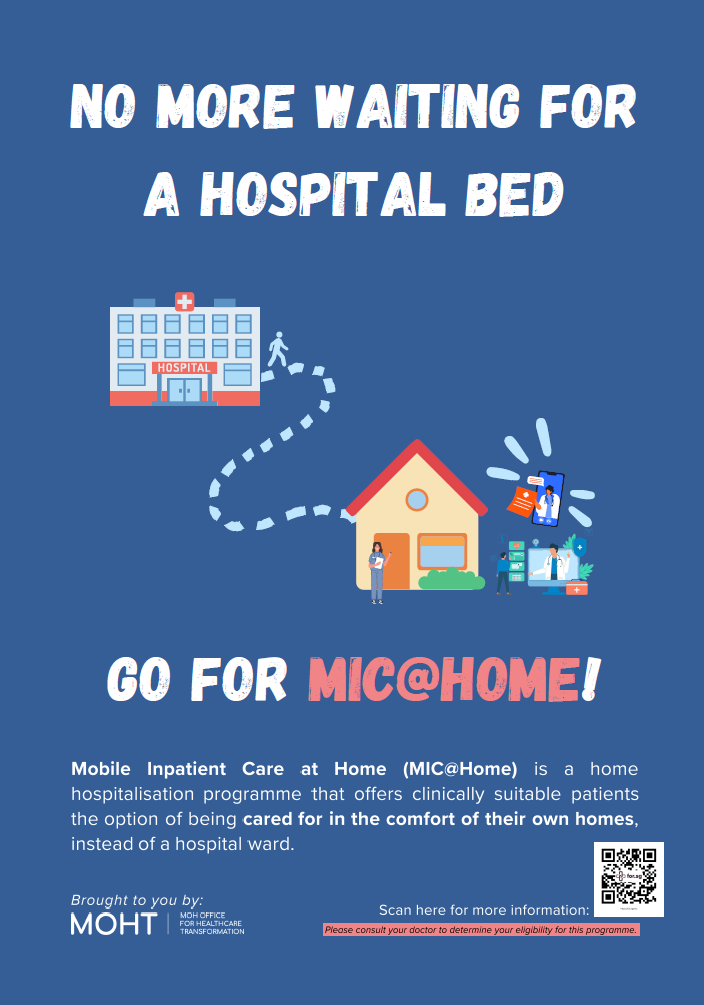
Mobile Inpatient Care @ Home (MIC@Home) is an alternative inpatient care delivery model that offers clinically-suitable patients the option of being hospitalised in their own homes, instead of a hospital ward.

.png)
.png)
.png)
Media room
Partners





Frequently Asked Questions
What is MIC@Home, or Hospital-at-Home, in general?
MIC@Home is the delivery of acute hospital care for suitable groups of patients in the patient’s home as a substitute for hospital in-patient care. Mobile hospital care teams deliver selected inpatient-level services at home, including regular visits by doctors, nurses and therapists, intravenous therapy, and investigations.
What is the difference between MIC@Home vs SGH@Home or NUHS@Home or KTPH@Home?
MIC@Home is the overarching term for the provision of hospital inpatient-level care in a home setting. Each hospital has designated this program with a name specific to their institution, although they all refer to the same initiative. For example, SGH runs the MIC@Home program under the name SGH@Home.
How is this different from Hospital-to-Home, Home Medical and Home Hospice?
MIC@Home provides acute hospital care in the patient’s home as a substitute for in-patient hospital care, whereas transitional care services (known sometimes as hospital-to-home, or H2H) provide post-discharge supportive care of recovered patients with the aim of providing medical care support to reduce re-admissions. Home medical services are provided by primary care providers and are not equipped to treat acute hospital care conditions. Home hospice services are specific services aimed at managing patients with terminal/life-limiting illness at home.
Inpatient hospitalisation has been well-developed in Singapore to fit our healthcare needs. Why do we need to explore alternatives?
With a rapidly ageing population and higher chronic disease burden, there will be an increase in demand for healthcare resources, including acute hospital beds. Building more hospitals will not be a sustainable solution.
Furthermore, elderly patients are especially susceptible to hospital acquired complications which include infections, functional deconditioning, disorientation, etc. The development of alternative models of care such as MIC@Home will mitigate some of these risks.
Who will be eligible for the MIC@Home service?
Patients should consult their doctors to determine their eligibility for MIC@Home. Generally, patients assessed as suitable are clinically stable, and while they require inpatient hospital care, their conditions are generally less severe. They will also need to be able to use tele-communications to communicate with the care team virtually. Patients would need to be able to communicate with the care team via virtual means such as through mobile phone or video-conferencing platforms. They can be safely cared for at home and manage their medications on their own or with the assistance of a caregiver.
What are some examples of cases that are eligible for MIC@Home?
Majority of the cases in MIC@Home are adult general medicine cases. The top few diagnoses include cellulitis, urinary tract infection, pneumonia, exertional rhabdomyolysis, dengue, uncontrolled hypertension, diabetic complications.
Examples of diagnoses under the specialty use cases include neonatal jaundice, paediatric eczema, pelvic inflammatory disease, terminal discharge cases (<1 week).
What types of inpatient services are provided under MIC@Home?
The MIC@Home program offers comprehensive home-based care through a multidisciplinary team which includes doctors, advanced practice nurses (APNs), staff nurses, pharmacists, therapists and medical social workers as appropriate.
Care is provided via a hybrid of home visits, virtual consultations and remote monitoring as required. Medication management includes counselling either done in-person in the hospital before the patient leaves for home or provided via tele-consult. Intravenous and oral medication will be dispensed regularly.
Patients will receive comprehensive instructions on how to monitor and report their vital signs accurately. The monitoring devices will be loaned to patients during the treatment period as required. No extra charges are levied on equipment loaned and the equipment will be collected at the end of the admission. The program ensures rigorous monitoring and documentation of adverse events, such as falls, pressure injuries, and medication errors. It supports a range of procedures including intravenous hydration and antibiotics, ultrasound bladder scanning, ECG, wound care, urinary catheter insertion, venipuncture, and intravenous cannulation.Therapy services such as postural hypotension management, acute functional decline physiotherapy, occupational therapy for home assessment can be provided.
Continuous support is available through a dedicated round-the-clock hotline, ensuring that patients have access to care and assistance at all times.
What are the care escalation protocols if patients deteriorate at home or encounter problems after hours, and what steps are taken in the event of a medical emergency?
The care team is accessible 24/7. If patients deteriorate at home, during office hours, calls from patients are handled by the MIC@Home staff, who would escalate to the doctor if needed. After office hours, calls from patients are routed to on-call doctors for assessment and appropriate action.
Patients and caregivers are educated to monitor for signs and symptoms in a medical emergency. If the signs and symptoms are observed, caregivers are to call 995 immediately. Additionally, to mitigate the risks of deterioration, participating hospitals in MIC@Home implement measures such as careful patient selection, alerts for abnormal vital signs, and informed consent allowing for hospital transfer if needed.
Will I be able to leave my home during the duration of my hospitalisation under MIC@Home?
For your own safety and well-being, patients under MIC@Home programme are encouraged not to leave their homes for the duration of their hospitalisation. If there is a need to leave home, please discuss with the care team on home leave arrangements.
Will I be able to get a medical certificate (MC) / hospitalisation leave (HL) if I am under the MIC@Home programme?
Yes, similar to an inpatient stay, you will be eligible for medical certificate (MC) / hospitalisation leave for the duration of your admission under MIC@Home and after discharge if medically appropriate. If required, you can be provided with memorandums to relevant parties regarding your condition that was treated under the service.
Does MIC@Home transfer caregiver burden from hospitals to patients and their families?
Patients and their families do take up more active roles in caring for the patient during their MIC@Home admission. These may include assisting with ADLs (Activities of Daily Living) and measuring vital signs (temperature, blood pressure, and oxygen saturations).
A study conducted by NUHS, one of the pilot sites for MIC@Home, noted most of the caregivers and patients felt the programme provided comfort and convenience. Caregivers who opted for MIC@Home felt more involved in patient care and were motivated by a sense of duty to enable their loved ones to recover in a familiar environment at home.
There are other benefits as well. Programme nurses are able to provide more targeted caregiver training and education in the patient’s home environment and assess patient self-management and caregiver competency, which are all key factors to empower patients and their caregivers to manage their own care and health.
I do not have a caregiver at home / I live alone, am I excluded from this program?
You are expected to be able to self-care and self-administer oral medications if you do not have caregiver support. If you stay alone, please inform the care team who will discuss additional safety measures with you.
We recommend utilising delivery services for your daily needs to ensure convenience and safety.
Is MIC@Home more expensive compared to an inpatient hospital stay?
From April 2024, MIC@Home has become a mainstream model of care in our public healthcare institutions. All our hospitals intend to price MIC@Home similar to or lower than a normal hospital ward. Patients will be supported by subsidies, MediShield Life and MediSave, no different from a physical inpatient stay. In addition, patients can also utilise their Civil Service Card and Integrated Shield Plans (please check with respective Integrated Shield Plans provider on the details of your coverage).
Resources
Click on the links for more information about eligibility, financial support, and more details about MIC@Home.
MIC@Home Patient Brochure (English)
MIC@Home Patient Brochure (Chinese)
.png)