
MIC@Home
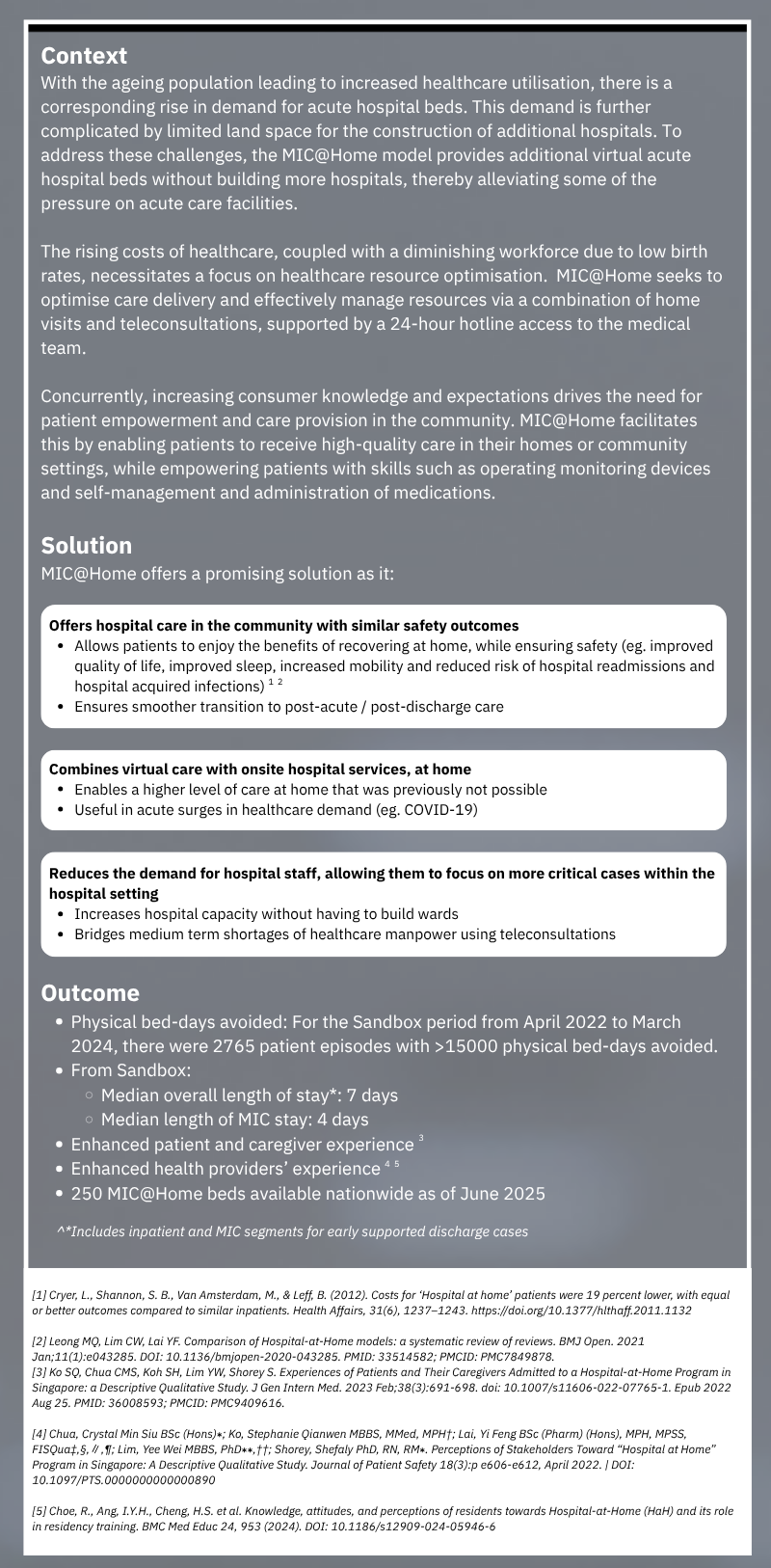
It is an alternative inpatient care delivery model that offers suitable patients the option of being hospitalised in their homes, instead of a hospital ward. The programme utilises a hybrid approach of teleconsultations and home visits by a multi-disciplinary care team, supported by remote clinical monitoring and other community-based services. This not only allows patients to recover comfortably at home but also helps to alleviate the bed crunch and resourcing strain on the healthcare system.
For Healthcare Professionals
.png)
About MIC@Home
Singapore’s Mobile Inpatient Care @ Home (MIC@Home) programme allows eligible patients to receive hospital acute-level care in the comfort of their own homes. This comprises a hybrid approach of home visits by a care team, and remote clinical monitoring, supported by a multidisciplinary team and other community-based services. This innovative approach not only provides a pleasant recovery experience for patients but also helps to alleviate bed crunch and resourcing strain on the healthcare system.

MIC@Home Sandbox Clinician Leads

Asst Prof Jean Lee Mui Hua (SKH)
Senior Consultant, Transitional Care and Community Medicine, Sengkang General Hospital
With the ageing population, overcrowding in the hospital is a growing problem. I was keen to offload it by allowing the less serious cases to recover at home.
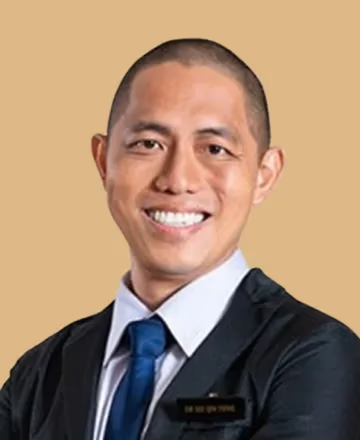
Dr See Qin Yong (CGH)
Consultant, Care & Health Integration, Changi General Hospital
From the patients’ perspectives, they love the programme and enjoy the experience of recovering in the comforts of their home – dream state. Patients are also hearing about the programme from their friends, and it shows that the programme has permeated through the ground and is getting recommended to others.
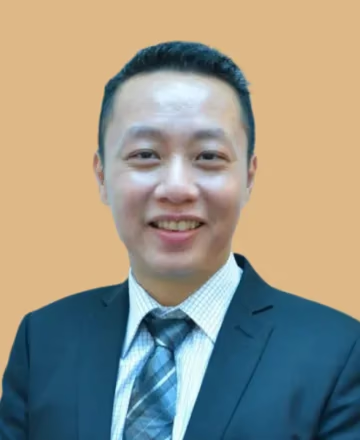
Assoc Prof Mark Koh Jean Aan (KKH)
Head & Senior Consultant, Dermatology Service, KK Women's and Children's Hospital, Deputy Campus Director, Medical Innovation and Care Transformation, Service Chief SingHealth Duke-NUS Vascular Centre
Patients benefit most from MIC. Some parents prefer KKH@Home due to concerns about increased infection risks in hospitals and high noise levels that might affect their child’s sleep.

Dr Boh Toon Li (KTPH)
Clinical lead for the Medical Home Programme Consultant Geriatric Medicine Khoo Teck Puat Hospital
Our data reported significantly shorter LOS, non-inferior clinical and functional outcomes, superior experiential outcomes (from both patient and caregiver perspectives) and significantly lower caregiver stress levels at 90 days post discharge.

Dr Ang Yan Hoon (KTPH)
Senior Consultant Geriatric Medicine, Internal Medicine Khoo Teck Puat Hospital
Our data reported significantly shorter LOS, non-inferior clinical and functional outcomes, superior experiential outcomes (from both patient and caregiver perspectives) and significantly lower caregiver stress levels at 90 days post discharge.

Dr Stephanie Ko Qianwen (NUH)
Consultant, Advanced Internal Medicine, National University Hospital Lead, NUHS@Home
Patients generally have a better experience recuperating in a familiar environment around their family. This kind of experience has been replicated both from not only from my anecdotal experience as a clinician, but also based on research studies that we’ve done on patient experience in Singapore.
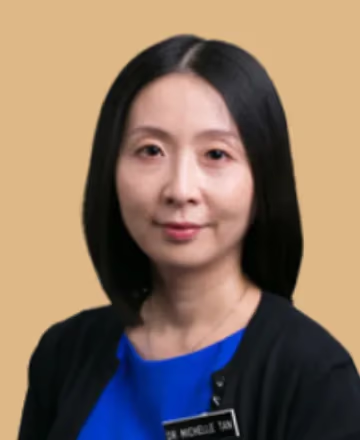
Dr Michelle Tan Woei Jen (SGH)
Head and Senior Consultant, Family Medicine and Continuing Care, Singapore General Hospital
We have observed a reduction in hospital readmissions, improved patient satisfaction scores, and enhanced quality of life indicators, which have been pivotal in sustaining the program.
The main benefits include personalised care in the comfort of their homes, faster recovery times, and a significant reduction in the stress associated with hospital stays.

Adj Asst Prof Endean Tan Zie Hean (TTSH)
Clinical Director of TTSH@Home
Bringing this care into patients’ own homes will not only enable them to recover in a familiar environment but allow caregivers to be more involved in the recovery journey.
.png)
Dr Pauline Seah See Joon (WH)
Consultant, Geriatric Medicine, Clinician Lead of WH@Home
We are heartened to hear positive feedback directly from patients and caregivers who have been recipients of our service. One of our previous patients was also featured on Channel 8 TV show Frontline in July 2024 where he shared his personal experiences with MIC@Home. Most of the positive feedback is focused on freedom, flexibility and comfort of being cared for at home and spending time with their loved ones, while receiving non-inferior acute clinical care by healthcare professionals.
Journal Articles
Perceptions of Hospital-at-Home Among Stakeholders: a Meta-synthesis: https://link.springer.com/article/10.1007/s11606-021-07065-0
Comparison of Hospital-at-Home models: a systematic review of reviews: https://bmjopen.bmj.com/content/11/1/e043285
Technology‑enabled virtual ward for COVID management of the elderly and immunocompromised in Singapore: a descriptive cohort: https://bmcinfectdis.biomedcentral.com/articles/10.1186/s12879-023-08040-2
Economic Evaluation of Novel Models of Care for Patients With Acute Medical Problems: https://jamanetwork.com/journals/jamanetworkopen/fullarticle/2809787
Asian Attitudes and Perceptions Toward Hospital-At-Home: A Cross-Sectional Study: https://www.frontiersin.org/journals/public-health/articles/10.3389/fpubh.2021.704465/full
Perceptions of Stakeholders Toward “Hospital at Home” Program in Singapore: A Descriptive Qualitative Study: https://journals.lww.com/journalpatientsafety/abstract/2022/04000/perceptions_of_stakeholders_toward__hospital_at.16.aspx
Treating patients at home: A novel solution for old problems: https://annals.edu.sg/treating-patients-at-home-a-novel-solution-for-old-problems/
Hospital-at-home as a first-line strategy for kidney transplant recipients with coronavirus disease 2019 infection: https://www.amjtransplant.org/article/S1600-6135(23)00456-2/fulltext
Continuous Vital Signs Monitoring in Patients Hospitalized at Home: Burden or Benefit?: https://www.jamda.com/article/S1525-8610(23)00232-3/fulltext
Treating acutely ill patients at home: Data from Singapore: https://annals.edu.sg/treating-acutely-ill-patients-at-home-data-from-singapore/
Experiences of patients and their caregivers in a Virtual Ward in Singapore: A descriptive qualitative study: https://www.sciencedirect.com/science/article/abs/pii/S1386505623001296?via%3Dihub
Distilling lessons from home hospital implementation: a narrative scoping review: https://journals.lww.com/smj/fulltext/9900/distilling_lessons_from_home_hospital.93.aspx
Knowledge, attitudes, and perceptions of residents towards Hospital-at-Home (HaH) and its role in residency training: https://bmcmededuc.biomedcentral.com/articles/10.1186/s12909-024-05946-6