
A Day in the Life of a Speech Therapist at MOHT
19 May 2026
A Day in the Life at MOHT series
One of MOHT’s strengths stems from having a pool of talents from diverse backgrounds, facilitating the cross-diffusion of learning and insights within the organisation and across the ecosystem.
“A Day in the Life at MOHT” is an MOHT blog series where featured colleagues relate how their individual talent, experience and practice has enriched MOHT’s tapestry of contributions towards the transformation of Singapore’s healthcare.
In this eleventh edition, we take a look at a day in the life of Senior Speech Therapist Charilyn Ong, who was seconded to the Integrated General Hospital team at MOHT.
Contributed by Charilyn Ong
From clinical practice to system transformation
In my fifth year as a speech therapist, I had the opportunity to join the MOH Office for Healthcare Transformation (MOHT) through the 2025 Public Healthcare Stretch Projects, a programme under MOH Holdings (MOHH) that offers public healthcare professionals exposure to system-level work through short-term postings outside their home institutions. Through this one-year secondment, I had the privilege of working with the Integrated General Hospital (IGH) team.
In my clinical role as a hospital-based Speech Therapist, I support patients who have language, cognition, speech and swallowing difficulties. This grounding has shaped how I see healthcare from the eyes of the people I serve: the patients and caregivers.
My part-time secondment, during which I worked two days a week in MOHT, broadened my perspective beyond individual patient care to system level transformation. It also deepened my understanding of how the healthcare system works, including the considerations behind decisions that are not always visible on the ground.
I was therefore pleased to turn this perspective into practice by being part of the Community Hospital of the Future (CHoF) project, a national care redesign initiative that redefines the role of community hospitals. CHoF aims to ease pressure on acute hospitals by enabling patients to be transferred earlier or admitted directly from the community. This supports the national shift towards more coordinated and sustainable post-acute-hospital care.
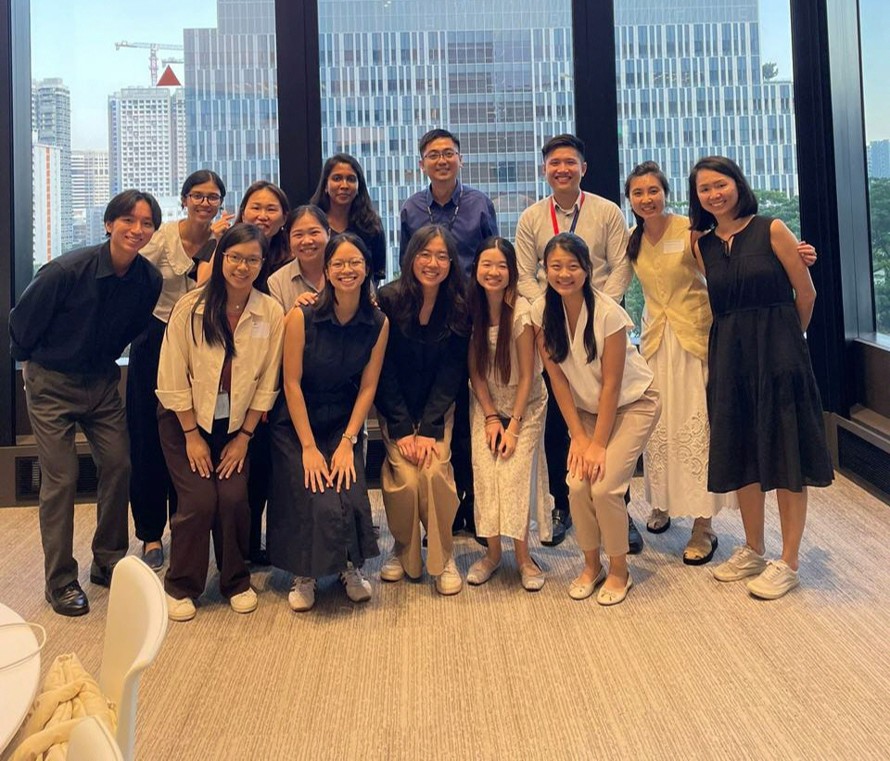
The CHoF team and I (front row, far right) at the Consensus-Building Workshop held on 1 July 2025
My primary project focused on the development and application of tele-rehabilitation. I conducted literature reviews and environmental scans of the local and international tele-rehabilitation landscapes. It is crucial to consider incorporating tele-rehabilitation into CHoF as it allows patients to continue their rehabilitation from home or in the community. This eases the transition from hospital back to daily life and allows for earlier supported discharge, reducing rehabilitation downtime as well as optimising manpower. By extending therapy beyond hospital walls, it expands access, supports continuity of care, and helps community hospitals deliver more sustainable, patient-centred outcomes.
Drawing from my research and data analysis, I was able to develop a position paper that consolidates findings from various tele-rehabilitation trials conducted both locally and internationally. This comprehensive review was designed to guide policy development by examining key considerations, creating clear guidelines for management, oversight and funding. These include determining patient suitability criteria, ensuring safety during digital care delivery, identifying technology infrastructure requirements, and examining the cost-effectiveness compared to traditional in-person care.
I hope our recommendations will help shape how tele-rehabilitation can be scaled responsibly across hospitals and the community providers and provide evidence-based guidance to inform future policy development and clinical practice in this evolving area of healthcare delivery.
I especially valued the engagements with stakeholders across healthcare clusters, community partners, and vendors, where I learned about the practical realities of implementing tele-rehabilitation, what drives uptake among patients and clinicians, and how outcomes are being measured across different care settings. Beyond the tele-rehabilitation project, I also took part in stakeholder conversations, proof-of-concept discussions, and a two-day consensus-building workshop with community hospital and healthcare policy partners. These engagements underlined the importance of strong partnerships to system-level transformation. Shared ideas and learning are also crucial in guiding policies and implementation plans.
Building an online solutions repository – where I consolidated innovation projects across hospitals in collaboration with a computer science intern – gave me exposure to work vastly different from my clinical background and provided in-depth insight into various projects across the system. This deepened my understanding of the resourcing and sustainability considerations behind care models. I have also learned to apply the “What/So What/Now What?” learning framework to guide discussions and planning - a simple, structured reflection model that helps us make sense of experiences, draw insights, and decide on next steps. This discipline has pushed me to think beyond clinical effectiveness, towards what is scalable, operationally feasible, and sustainable across the broader healthcare system.
Lasting lessons and friendships
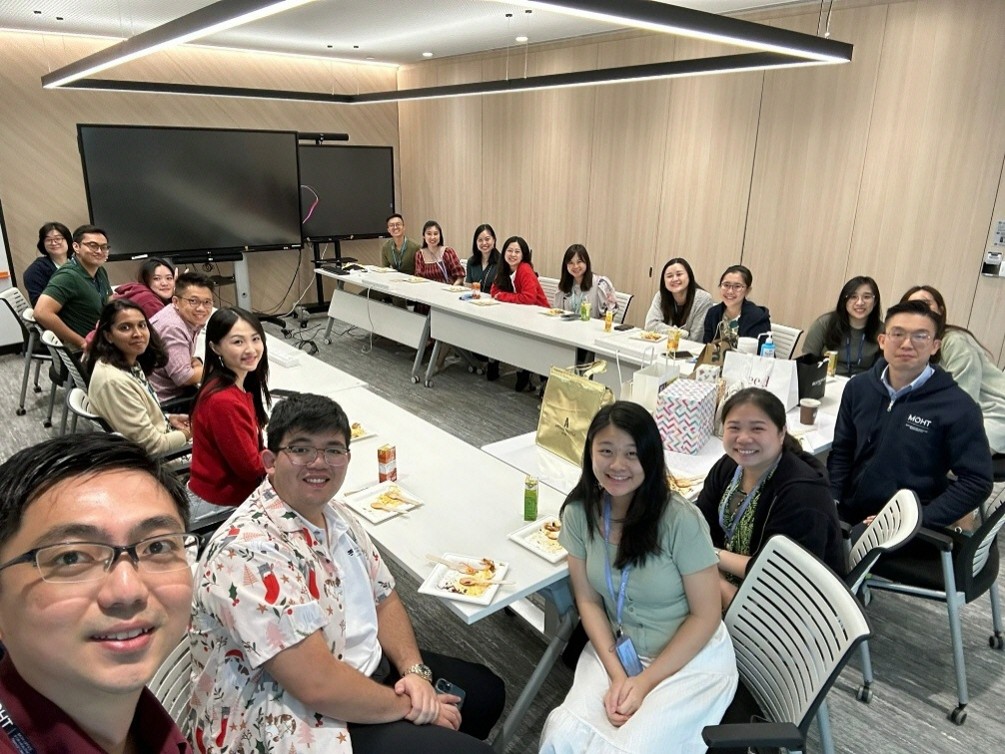
The Integrated General Hospital team and I (front row, third from left) at our team's Christmas Party
While I appreciated the collaborative discussions with my MOHT colleagues, where we exchanged ideas and sharpened our thinking, some of the most meaningful moments came from the memories we made during lunches, pantry conversations and the various MOHT events, such as National Day, the Year-End Gathering, and our team‑bonding activities. The friendships forged during this stint are ones I will carry with me long after I leave.
As I return to clinical practice, I now have a deeper appreciation of what the needs are in a diverse rehabilitation landscape, and how different parts of the healthcare system connect. This broader view now shapes how I approach patient care, and enables me to contribute purposefully in my role, to create meaningful impact.
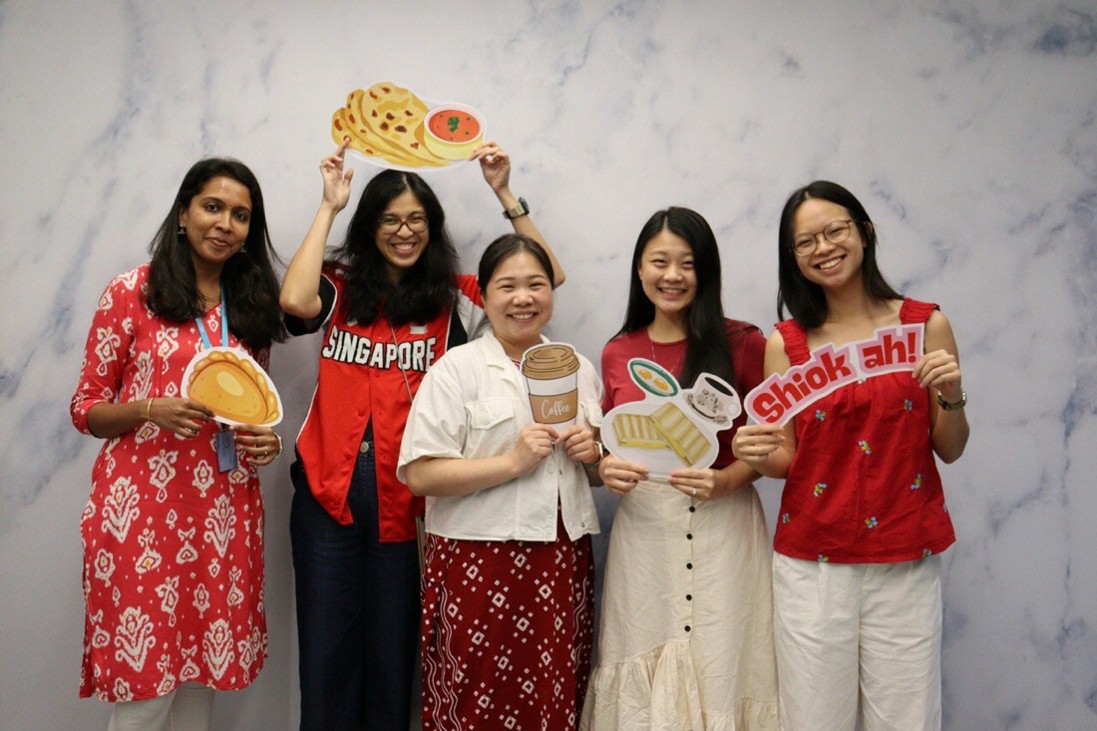
Sharing SG60 moments with my Integrated General Hospital teammates at MOHT’s National Day celebration (I’m second from right)